



|
Стратегическая ценность Центральной Азии вызывает дипломатическую конкуренцию между крупными державами
|
20-го числа в Международном конференц-центре в Токио, Япония, премьер-министр Японии Санаэ Такаичи, президент Казахстана Касым-Жомарт Токаев, президент Узбекистана Шавкат Мирзиёев, президент Туркменистана Сердар Бердымухамедов, президент Кыргызстана Садыр Джапаров и президент Таджикистана Эмомали Рахмон собрались в одном месте. Шесть лидеров, участвовавших в саммите Япония-Центральная Азия — учреждённом в этом году и прошедшему в течение двух дней, начиная с предыдущего дня — приняли «Токийскую декларацию» перед заключительным заседанием.
Ключевые пункты декларации включают Японию и пять центральноазиатских стран, которые ведут экономическое сотрудничество на общую сумму 3 триллиона иен (примерно 28,22 триллиона корейских вон) за пять лет, укрепление ключевых цепочек поставок полезных ископаемых и создание рамок сотрудничества в секторе искусственного интеллекта (ИИ). Такаити выразил благодарность, заявив: «Для меня честь провести первый саммит с Центральной Азией.» В ходе встречи между Японией и пятью странами Центральной Азии было подписано более 150 соглашений. Лидеры договорились организовать саммит и провести следующий в Казахстане.

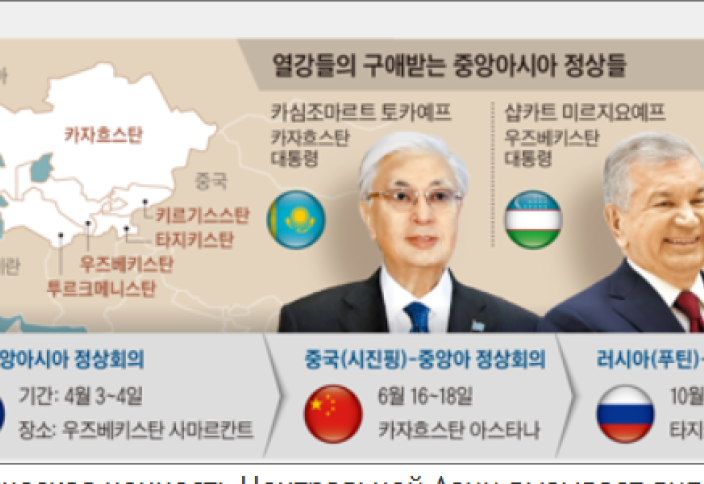
Following the U.S., China, Russia, and the European Union (EU), Japan’s establishment and hosting of a summit mechanism with the five Central Asian nations have intensified diplomatic competition among major powers over the region. Since April, the Central Asian leaders—long perceived as peripheral—have held summits with the EU, China, Russia, the U.S., and Japan in succession, showcasing their elevated status. Analysts attribute this shift to the region’s renewed strategic value as a resource-rich and geopolitically pivotal area amid prolonged wars (Russia-Ukraine, Israel-Hamas), a new Cold War structure, and U.S. isolationism under Trump’s re-election.
The five Central Asian leaders, former Soviet states and predominantly Muslim, have historically acted as a unified bloc on certain issues, but their stature has risen unprecedentedly this year. In April, the first EU-Central Asia summit was held in Samarkand, Uzbekistan. It drew attention as the first high-level diplomatic engagement between the two blocs, which differ in religion and political systems. Ursula von der Leyen, EU Commission President, and António Costa, President of the European Council, met with the five leaders and elevated bilateral relations to a strategic partnership.
In June, the five leaders convened in Astana, Kazakhstan, to meet with Chinese President Xi Jinping. This marked the second China-Central Asia summit, held two years after the first in Xi’an in May 2023. Xi Jinping, citing classical Chinese idioms like “mutual support in times of adversity” and “rowing the same boat,” urged, “Let us overcome difficulties and advance toward the goal of building a China-Central Asia community with a shared future.”
In October, the five leaders met with Russian President Vladimir Putin at the Russia-Central Asia summit in Dushanbe, Tajikistan. Putin had previously hosted a Russia-Central Asia summit in October 2022, a year before Xi Jinping.
The U.S. also intensified diplomatic engagement with Central Asia. U.S. President Donald Trump hosted a state dinner for the five leaders at the White House in Washington, D.C., during last month’s U.S.-Central Asia summit. The meeting announced cooperation plans in minerals and digital sectors, including a $2 billion AI center in Kazakhstan by U.S. companies like NVIDIA and OpenAI. The U.S.-Central Asia summit was established in 2023 under former President Joe Biden. Trump’s continuation of the mechanism is seen as recognizing Central Asia’s leverage in countering China and Russia.
By attending the Japan-Central Asia summit, the five Central Asian leaders have met with major powers from both the free world and authoritarian blocs within eight months. Central Asia, a resource-rich region with vast reserves of oil, uranium, gold, and rare earths, is a geopolitical hub connecting Russia, India, the Middle East, Europe, and China. It also serves as a buffer zone adjacent to unstable regions like China’s Xinjiang, Iran, Pakistan, and Afghanistan.
Analysts predict Central Asia will further enhance its diplomatic presence by leveraging these advantages. The Diplomat, a U.S. foreign policy journal, noted, “Diversified diplomacy, where nations avoid aligning with specific blocs or major powers, has become a new trend, and Central Asia is emerging as a new middle power.”