




|
Как апельсины меняют жизни в Аргаханчи
|
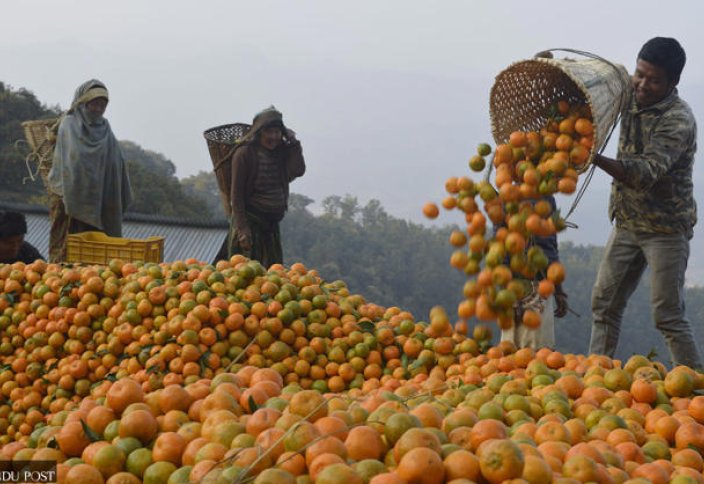
В сельском муниципалитете Панини-1 города Аргаханчи сад молодого фермера Ревати Бхаттараи стал символом того, как коммерческое выращивание апельсинов может изменить жизни.
Его 535 апельсиновых деревьев сейчас приносят плоды. В прошлом году он продал 170 центнеров апельсинов, оформив оборот в 900 000 рупий. В этом году, когда новые деревья начинают плододавать плоды, а старые сильно нагружены, он оценивает, что производство может достичь до 200 центнеров.
Сбор урожая уже начался, спелые жёлтые апельсины собираются и отправляются на рынок.
Торговец из Бутвала Дживалал Пандей забронировал сад Бхаттарая ещё до того, как плоды полностью созрели.
«Наша задача — производить. Торговцы приходят к нашему порогу, как только появляются зелёные плоды, и бронируют деревья», — сказал Бхаттараи. «Когда сад будет забронирован, наша обязанность — заботиться о деревьях и защищать плоды. Мы планируем собирать урожай в ящиках с середины января, хотя некоторые фрукты уже отправлены на рынок.»
После сбора урожая апельсины упаковывают в ящики и перевозят на грузовике в Бутвал теми же торговцами. Цены обсуждаются при выборе. В прошлом году апельсины продавались по цене 60 рупий за килограмм на розничных рынках; в этом году цена выросла до 70 рупий.
После окончания 12 класса Бхаттараи несколько лет работал за рубежом. Он вернулся домой десять лет назад и посадил апельсины на земле, где когда-то выращивали зерновые культуры.
Encouraged by a reliable market, he gradually converted all his fields into orange orchards. Income from oranges has enabled him to build a two-and-a-half-storey concrete house in Simle.
"More than foreign employment, orange farming changed my life," he said. "There is no fear of unsold produce. Traders book the trees while the fruits are still green, so I don't even have to run after markets."
Dadhi Ram Gautam, a retired agricultural technician, is devoted to orange farming at home for the past five years.
His annual income from oranges is three times his pension pay. Almost all of his 250 fruit-bearing trees have already been booked, leaving only four or five trees for household consumption and guests.
"Traders from Butwal, Palpa and Pokhara call and come directly to my house to inspect and buy," he said. "They bring their own vehicles and transport the oranges themselves. There is no need to sell on credit."
Once harvested, oranges are sorted and packed into crates based on size-large, medium and small-each category fetching a different price.
Traders often purchase entire trees or even whole orchards on contract.
Chandrakant Paudel, ward chair of Panini-2, manages his orange orchard alongside his public duties.
His orchard has already been booked by traders.
"Production has increased compared to last year," he said. "There was no hailstorm, and pests and diseases did not attack the trees. Income will be higher this year."
Out of 600 trees, around 350 fruit-bearing ones are heavily laden. Paudel is now waiting for the right time to harvest while keeping an eye on potential prices.
In Sallery Tole of Panini-1, almost every household has an orange orchard. As demand and income improved, farmers abandoned cereal crops and planted oranges in their fields.
To organise farming practices and mobilise support, they formed the Pakhapani Farmers' Group. Out of 45 orange-growing households, 30 are members of the group. The largest orange grower in the village is Tuk Bahadur Darlami, who earned Rs350,000 last year from 150 fruit-bearing trees.
"Orange farming is a reliable agricultural business that provides continuous income," said Darlami, who is also a ward member. "Our entire Salleri village has turned into an orange hub. Oranges have ensured our fields are not left barren, and migration from the village is minimal."
Some farmers are nurturing new saplings in anticipation of future yields.
"When the whole village turns yellow with ripening oranges, it looks beautiful and lively," Darlami said. "This year, with no hailstorms or pest attacks, the trees are heavily laden."
Traders from Butwal have already made a deal to buy from the orchards, he added.
Through the farmers' group, growers regularly meet to discuss planting techniques, orchard management, fertilisation and ways to produce larger fruits.
Last year, the Agriculture Knowledge Centre helped construct two water tanks, each with the capacity for 1,500 litres, which are now used for irrigation.
More tanks are planned. With proper care and nutrition, oranges offer high returns, farmers say. Income from orange farming has made it easier to manage household expenses, educate children and improve homes and cattle sheds.
Another young farmer, Bishnu Bhattarai, said oranges have begun to ripen this year and yields are promising, raising hopes that income will surpass last year's earnings.
Panini-1, Simle is the largest orange-producing area in the district.
Seeing the substantial income of Simle farmers, growers in neighbouring villages have also expanded orange cultivation. Each year, Simle alone generates more than Rs30 million from oranges. This season, orchards across the area are once again glowing yellow with ripe fruit.
Sharda Acharya, a technician at the Agriculture Knowledge Centre, said that commercial orange farming is expanding in Simle as well as in Pokharathok, Khidim, Panena, Maidan, Mareng, Bhagwati and Arghatosh, Khandaha and Hanspur Sakindhara villages.
She said this year's strong production could significantly increase economic activity across these areas.