





|
Индонезия получила возможность стать мировым лидером в исламской экономике: генеральный директор Media Group
|
Индонезия получила возможность стать мировым лидером в исламской экономике: генеральный директор Media Group
Джакарта: Индонезия укрепляет свои позиции как крупного игрока в мировой исламской экономике. Согласно последнему отчёту о состоянии глобального индикатора исламской экономики 2025 года, Индонезия занимает третье место в глобальной экосистеме исламских финансов.
Это достижение отмечает три года подряд, в течение которых Индонезия сохраняет своё место среди сильнейших исламских экономических экосистем мира наряду с Малайзией и Саудовской Аравией.
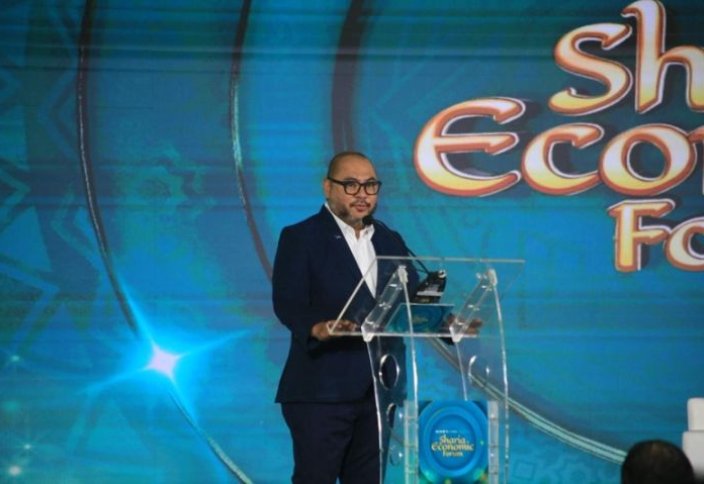
Выступая на Шариатском экономическом форуме под названием «Ускорение роста и процветания: путь к глобальному влиянию», генеральный директор Media Group Мохаммад Мирдал Акиб отметил, что этот этап служит стратегической основой для дальнейшего развития Индонезии. В отчете оцениваются страны по семи ключевым секторам — от халяльной пищи до скромной моды.
«Отчёт оценивает результаты стран в семи основных секторах: халяльное питание, исламские финансы, туризм, дружественный к мусульманам, скромная мода, халяль-косметика и фармацевтика, медиа и отдых, а также халяльные инвестиции», — заявил Мирдал в четверг, 12 февраля 2026 года.
В свете положительной тенденции Мирдал подчеркнул, что пришло время Индонезии двигаться вперёд и позиционировать себя как мирового лидера в исламской экономике. Его оптимизм подтверждается значительными экономическими данными. Мировые потребительские расходы мусульман достигли 2,43 триллиона долларов США (около 40 000 триллионов рупий) и, по прогнозам, вырастет до 3,36 триллиона долларов к 2028 году.
«Согласно отчёту о состоянии глобальной исламской экономики 2023 года, мировые потребительские расходы мусульман достигли 2,43 триллиона долларов США, или примерно 40 000 триллионов рупий, и прогнозируется увеличением до 3,36 триллиона долларов США, или примерно 55 000 триллионов, к 2028 году», — сказал он.
Помимо потребления, мировые исламские финансовые активы достигли 4,93 триллиона долларов США, а потенциал роста оценивается в 7,53 триллиона долларов в ближайшие годы. Эти цифры свидетельствуют о том, что исламская экономика больше не является дополняющим сектором, а является огромным рынком, формирующим направление мировой экономики.
Усилия правительства по укреплению исламской экономики
Мирдал отметил, что правительство отреагировало на эту возможность, интегрировав исламскую экономическую политику в Национальный среднесрочный план развития (RPJMN) на 2025–2029 годы и Национальный долгосрочный план развития (RPJPN) на 2025–2045 годы. Стратегия направлена на укрепление реального сектора халяль-индустрии и оптимизацию исламских социальных финансов.
«Правительство интегрировало исламскую экономическую политику в RPJMN 2025–2029 и RPJPN 2025–2045, сосредоточившись на реальных секторах халяльной индустрии и исламском социальном финансировании. Стать мировым лидером в исламской экономике стратегически важно для Индонезии, поскольку глобальная исламская экономика представляет собой огромный рынок», — сказал он.
Однако Мирдал предупредил, что для достижения этой цели потребуется коллективные усилия. Это включает укрепление экосистемы через синергию политики, развитие квалифицированных специалистов в исламских финансах и халяльных отраслях, ускорение цифровизации финансов и повышение общественной грамотности для обеспечения всестороннего процветания для всех индонезийцев.
Jangan lupa ikuti update berita lainnya dan follow akun
Google News Metrotvnews.com

How Islamic Finance Fits into Indonesia’s Resilience Strategy
Early 2026 opened with a note of caution from global markets. Moody’s kept Indonesia’s sovereign rating at investment grade (Baa2) but revised its outlook to negative, citing policy predictability and fiscal risks. Around the same time, MSCI froze its review of Indonesia’s market classification, warning of potential pressure if transparency and market structure fail to improve.
This is not a crisis. But it is a reminder that market perceptions of governance, stability, and financial depth play a decisive role in shaping capital flows.
Against this backdrop, the discussion on economic resilience becomes increasingly relevant. The central question is straightforward: is Indonesia’s financial system sufficiently diversified to absorb global shocks? This is where Islamic finance deserves consideration — not as an ideological alternative, but as one pillar within the country’s broader resilience architecture.
A Timely Momentum
Indonesia’s Islamic finance sector has posted steady growth in recent years. As of June 2025, Islamic banking assets stood at about Rp 967 trillion ($57 billion), up 7.8% year on year — outpacing the national banking industry average. Market share remains modest at roughly 7–8% of total banking assets, but growth has consistently exceeded that of conventional lenders.
More broadly, total national Islamic financial assets — including sukuk, takaful, and sharia-compliant capital markets — surpassed Rp 13,000 trillion ($772 billion) by the end of 2025, accounting for more than 30% of Indonesia’s overall financial assets. Collections of Islamic social funds, such as zakat and waqf, have also risen by double digits, underscoring the potential to integrate commercial and social finance.
Globally, the halal economy — spanning food, pharmaceuticals, cosmetics, modest fashion, and tourism — is estimated to be approaching $4 trillion, driven by population growth and increasingly standardized halal certification. For Indonesia, home to the world’s largest Muslim population, this represents not just a domestic opportunity but a chance for global positioning.
Still, headline numbers alone do not make Islamic finance a cure-all. The more important question is how it contributes to systemic stability.
Risk Sharing as a Shock Absorber
Modern financial systems rely heavily on debt-based financing. While efficient during expansionary cycles, such models can amplify contractions when conditions reverse — a lesson underscored by the 2008 global financial crisis.
Islamic finance offers a different approach through risk-sharing mechanisms such as mudharabah and musyarakah, where profits and losses are shared according to capital contribution. In practice, many Islamic banks still rely heavily on murabahah (cost-plus sale structures). Even so, the underlying philosophy promotes closer alignment between financing and real economic activity.
Risk sharing tends to encourage more measured expansion. It may not deliver the fastest growth, but it can provide cushioning during periods of stress. Islamic banks’ non-performing financing ratios, which have hovered around 2–3% in recent years, point to relatively contained risk profiles. For Indonesia — exposed to external volatility ranging from global interest-rate normalization to trade fragmentation — diversifying financing models is a strategic asset. The goal is not to replace conventional banking, but to complement it.
The Advantage of a Dual Banking System
Since reforms to banking law in 1998, Indonesia has operated a dual banking system, allowing conventional and Islamic banks to function side by side under a unified regulatory framework overseen by Otoritas Jasa Keuangan and Bank Indonesia.
Many countries rely on a single dominant model. Indonesia runs two in parallel. Managed well, this is not a weakness but an institutional advantage.
Conventional banks bring market depth, efficiency, and global integration. Islamic banks contribute product differentiation, access to halal markets, and value-based partnership financing. Together, they can broaden the investor and depositor base.
Government sukuk, for example, has become an important source of budget financing while attracting both domestic and international sharia-mandated investors. Islamic banks also play a growing role in extending credit to small businesses and halal industries. If developed in synergy, the dual system can deepen financial markets, strengthen inclusion, and expand funding options for enterprises.
Structural Challenges Remain
Optimism, however, must be tempered with realism.
Islamic financial literacy remains below 40% in most surveys, with inclusion at just 12–13%. Islamic banking market share has stagnated at around 7–8% for several years. Financing-to-asset ratios are lower than in conventional banks, reflecting excess liquidity and limited sharia money-market instruments. Most Islamic banks also operate at small to mid-sized capital levels, constraining economies of scale.
Regionally, Indonesia faces competition from Malaysia and Gulf countries that have built more integrated Islamic finance ecosystems. Without stronger human capital, digital innovation, and cross-sector regulatory harmonization, global leadership will remain elusive.
Four priorities stand out.
First, consolidation and scale. The Islamic banking roadmap should encourage healthy mergers, disciplined spin-offs, and the creation of well-capitalized institutions capable of channeling larger volumes of productive financing.
Second, deeper sharia money markets and hedging instruments. Bank Indonesia’s role in expanding Islamic liquidity facilities and repo instruments is critical to lowering funding costs and improving financing ratios.
Third, integration of commercial and social finance. Zakat, productive waqf, and social sukuk could be combined to support strategic projects — from MSME financing to social infrastructure — delivering more direct impact on inequality and poverty reduction.
Fourth, digitalization and product innovation. Sharia fintech, halal supply-chain financing, and tighter integration with the halal industrial ecosystem can attract younger demographics and new entrepreneurs. With these measures, pushing Islamic banking market share into double digits over the next few years is achievable rather than aspirational.
Moving Beyond False Dichotomies
As many scholars have noted, Islamic and conventional banking can coexist and reinforce each other. Indonesia’s economic resilience will not hinge on a single model, but on building a diversified yet integrated financial architecture.
In that context, Islamic finance finds its relevance: enriching funding structures, expanding inclusion, and opening pathways to global halal markets.
Signals from rating agencies should be read not merely as pressure, but as a prompt for reflection. In an increasingly uncertain world, a diversified financial system — combining debt-based and partnership-based models — functions as institutional insurance. Indonesia already has this foundation through its dual banking framework. The challenge now is ensuring both systems move in the same direction: strengthening stability, raising productivity, and sustaining market confidence.
In a volatile global landscape, resilience is not just about growth figures. It is about the depth and durability of economic structures. Managed strategically and professionally, Islamic finance can become an important part of Indonesia’s defensive wall.
---
Iman Pambagyo is the Trade Ministry’s Director General of International Trade Negotiations (2012-2014, 2016-2020) and Indonesia’s Ambassador to the WTO (2014-2015).
The views expressed in this article are those of the author.