



|
Давно назревшее извинения Пакистана перед Бангладеш
|
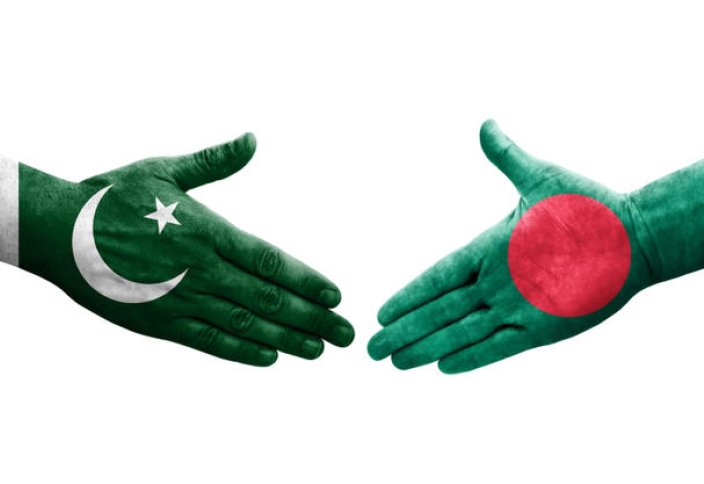
Визит министра иностранных дел Пакистана Ишака Дара в Дакку в августе 2025 года ознаменовался дружелюбными обменами, позитивными посланиями о региональном сотрудничестве и подписанием шести соглашений. Но когда Бангладеш вновь потребовал извинений за ужасы 1971 года, Дар заявил, что вопрос уже был «урегулирован дважды», по-видимому, намекая на Трёхстороннее соглашение 1974 года и «выражение сожалений» Парвеза Мушаррафа 2002 года. Когда сегодня (16 декабря) Бангладеш отмечает свою 54-ю годовщину со дня рождения, ключевой вопрос о извинениях Пакистана должен вновь всплывать.
Визит Дара стал прорывом в отношениях между Пакистаном и Бангладеш после падения режима Хасины. Однако его отказ от извинений отражает более глубокую реальность отношения Пакистана к своему прошлому. Для Бангладеш извинения — это незавершённое обязательство, несущее тяжесть закона и истории, но для Пакистана это дверь, которую лучше держать закрытой. Тем не менее, даже если Исламабад скажет слово, что Дакка ждёт уже 54 года, возникнет вопрос — будет ли достаточно «извини»?
Извинения имеют значение в международном праве. Это не просто жесты, а признанные формы возмещения, когда государства нарушают международные правовые обязательства. Статьи Комиссии по международному праву ООН о государственной ответственности указывают, что репарации могут принимать форму «удовлетворения» (статья 37) — принцип, который Международный суд ООН подтверждает в своих знаковых решениях по делу Корфу-Ла-Манш (Великобритания против Албании) и деле Габчиково-Надьямарош (Венгрия против Словакии), где признание правонарушений может требоваться для исполнения государственной ответственности.
Неохота Пакистана легко понять, ведь извинения за 1971 год также означали бы признание ответственности за военные преступления, преступления против человечности и, возможно, геноцид. Резни, изнасилования и массовые перемещения того периода не были обычными военными излишествами; они представляли собой самые тяжкие преступления, известные человечеству. Признать их — значит признать проступок высшего порядка, а с этим признанием следует ряд юридических, политических и экономических последствий. Экономически и политически хрупкий Пакистан в 2025 году не захочет вызывать такие последствия.
Pakistan fears that an apology might trigger demands for reparations, much as Germany's post-Holocaust apologies were tied to compensation. It could also amount to recognition of genocide, which carries obligations under the 1948 Genocide Convention to punish perpetrators (Article 4). Pakistan's parliament, by contrast, has condemned Bangladesh's war crimes trials. While some trials conducted during Hasina's regime were indeed worth condemning for lacking due processes that international law demands, a blanket condemnation was a move in the opposite direction. Moreover, one apology often begets another.
But even if such an apology comes, it cannot stand alone. While Germany apologised repeatedly for the Holocaust, it also mandated education, built memorials and created reparations programmes. Canada, too, did not stop at apologising to its indigenous people for the 'residential schools' system but also established a Truth Commission, funded cultural centres and created scholarship programmes. South Africa's transition from apartheid rested not only on apology but also on truth-telling and institutional reform.
What might this mean for Pakistan? Unlike an economically advanced power such as Germany or Japan, Pakistan might not have the financial surplus to pay significant reparations. But in any case, the enormity of the crimes of 1971 cannot be quantified in money alone, as the suffering was beyond calculation. If options for reparations in cash are limited, Pakistan's obligation must be discharged through other forms of acknowledgement and responsibility.
To begin with, Pakistan could revamp its school curricula. 'Pakistan Studies' textbooks continue to describe 1971 as the result of 'Indian aggression'. While that is partly true, to reduce the Bangladesh Liberation War to such narratives is a massive distortion, erasing atrocities committed by Pakistan. Honest curricula would acknowledge that it were not just the Indian tanks that destroyed Pakistan's unity but rather Pakistan's own actions against its own population.
Furthermore, Pakistan can fill the vacuum on 'memorialisation' by adding a section in its national museums-or even building a dedicated memorial-to memorialise the atrocities committed by its army. It can learn from Bangladesh, which has built the Liberation War Museum as a national repository of truth and memory. Releasing (officially) the report of the Hamoodur Rahman Commission (a war investigation commission led by Pakistan's ethnically Bengali Chief Justice Hamoodur Rahman, who chose to stay in Pakistan even after the division of the country), which documented massacres, rapes and misconduct by senior officers, will add yet another brick. Similarly, establishing 'Genocide Studies Centres' or endowing 'Transitional Justice Chairs' in Pakistani universities could create the intellectual and moral space for research and debate about 1971.
Pakistan has already offered gestures such as the Pakistan-Bangladesh Knowledge Corridor, which promises 500 scholarships for Bangladeshi students over five years. The Pakistan Technical Assistance Programme has also recently increased its scholarships for Bangladesh from five to twenty-five. Building these human bridges are useful steps, but without acknowledgement of the atrocities, they remain gestures of charity masquerading as goodwill rather than acts of reconciliation.
For Bangladesh, the demand for an apology from Pakistan is not only justified but also unavoidable. Yet when that apology comes, the next question will arise: Is 'sorry' enough? The answer is 'no', as words without deeds are hollow. Pakistan's present-day economic limits may constrain reparations-and 1971's crimes may defy quantification-but responsibility is not optional. The Pakistani apology-when it comes-must be accompanied by memorialisation, education, research and people-to-people exchange.
Internationally, 2025 is perhaps the most opportune moment for Pakistan to apologise to-and reconnect with-Bangladesh, especially as both countries' ties with hegemonic India remain strained. Domestically, however, in the wake of Field Marshal Asim Munir's dictatorial consolidation of power following India's illegal aggression in May (which has recently been reinforced by the 27th amendment to their constitution), apologising can hardly be the instinct of a leader whose legitimacy rests on projecting strongman-like strength. And in any case, even if that apology were to come, it would mark the beginning of a true reckoning only when accompanied by appropriate actions.