



|
Численность военнослужащих Южной Кореи упала на 31%, в то время как количество мужчин в возрасте 20 лет упало на 16%
|

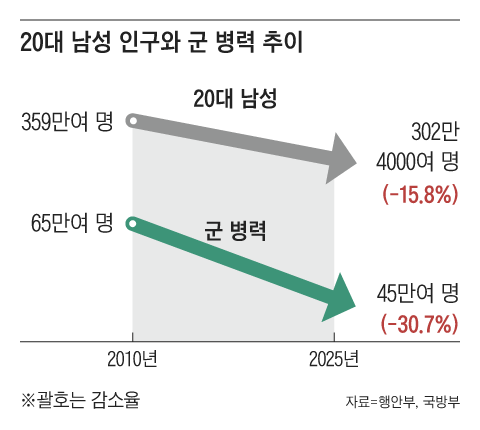
В этом году численность мужского населения в возрасте 20 лет составила примерно 3 024 000 человек, что на 15,8% меньше по сравнению с мужским населением в возрасте 20 лет в 2010 году, 15 лет назад. Между тем, военный персонал Южной Кореи, который в 2010 году насчитывал 650 000 человек (согласно Белой книге обороны), за 15 лет упал до 450 000 человек, то есть на 30,7%. Сокращение численности военнослужащих опережает естественную убыль годного населения. Анализ показывает, что популистская политика, направленная на сокращение сроков военной службы для привлечения молодых избирателей, ускорила военный кризис быстрее, чем сокращение ресурсов призыва из-за низкой рождаемости.
Сокращение сроков военной службы является устойчивой тенденцией со времен демократизации. Администрация Но Му Хена проводила план по сокращению срока службы в армии и морской пехоте до 18 месяцев к 2014 году под лозунгом «оборонной реформы». После потопления «Чхонана» в 2010 году и артиллерийского обстрела острова Ёнпхёндо, администрация Ли Мен Бака заморозила этот период на уровне 21 месяца. Бывший президент Пак Кын Хе пообещала сократить срок службы до 18 месяцев, но не реализовала его.
Вступившая в должность администрация Мун Чжэ Ина, вступившая в должность позже, с 2018 года постепенно сократила срок обязательной службы (исходя из армии) с 21 месяца, остановившись на нынешних 18 месяцах в 2021 году. Численность призывников, которых непосредственно затронул сокращенный срок службы, сократилась с 344 000 в 2021 году до 269 000 в этом году. Одновременно с этим при администрации Юн Сок Ёля продолжалось повышение месячного денежного довольствия солдат, начатое в тот же период, при этом месячная зарплата сержанта превысила зарплату младших офицеров.
Проблема в том, что этот период совпал с наступлением «демографического обрыва» из-за низкой рождаемости. Население Южной Кореи начало свою первую естественную убыль в 2020 году и сокращается уже шесть лет. В то время как население сокращается, неспособность скорректировать политику «сокращения войск» и трудности с набором офицеров привели к тому, что постоянные силы численностью 500 000 человек рухнули раньше, чем ожидалось.
Шесть выборов и сокращение с 30 до 18 месяцев... Военные теряют войска, в то время как правительства набирают голоса
Since democratization, the military service period (based on the army) has been reduced from 30 months to 18 months over six presidential elections. Both left- and right-wing candidates have uniformly pledged to shorten the service period. Go Seong-yoon, representative of the Korea Military Science Forum, stated, “When a presidential candidate promises to shorten the service period, the opposing candidate follows suit, exemplifying populism.”
The Roh Tae-woo administration began gradually reducing the 30-month period to 26 months. Although not realized, during the 1992 election, Kim Young-sam pledged a reduction to 24 months, and Kim Dae-jung to 18 months. Former President Roh Moo-hyun, who advocated a four-month reduction during his campaign, shortened it by two months to 24 months after taking office. In 2007, late in his term, he initiated a plan to gradually reduce the period to 18 months by 2014.
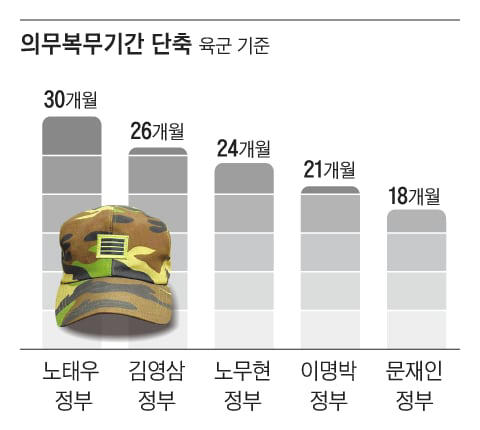
Former President Lee Myung-bak followed this policy but set the service period at 21 months after the 2010 Cheonan sinking and Yeonpyeong Island artillery attack. Former President Park Geun-hye pledged an 18-month service period during her campaign but abandoned the plan after taking office, citing difficulties in troop supply as stated by the Ministry of National Defense and the Military Manpower Administration. Former President Moon Jae-in pledged and implemented the 18-month period. Former President Yoon Suk-yeol did not pledge to shorten soldiers’ service but promised to reduce the service period for Reserve Officers’ Training Corps (ROTC) officers from 28 to 24 months during his campaign.
In 2010, after the Cheonan sinking and Yeonpyeong Island artillery attack, there were calls to revert the service period to 24 months. However, the conclusion was to halt the reduction at 21 months, based on the 18-month plan decided under the Roh Moo-hyun administration. A military source said, “The military lost troops when politicians gained votes,” adding, “The Ministry of National Defense provided logic that reducing troops was acceptable according to the government’s preferences.” The Moon Jae-in administration promoted “mixed manned and unmanned units for troop reduction,” and the Yoon Suk-yeol administration emphasized concepts like “AI science and technology-powered military,” claiming no issues with military readiness despite reduced personnel.
Experts argue that shortening the service period to 18 months has inevitably weakened not only troop numbers but also combat capabilities. According to the Korea Institute for Defense Analyses, the minimum required service period for each army specialty (based on advanced proficiency) is 16 months for infantry, 17 months for artillery, 21 months for armor, 18 months for communications, and 21 months for maintenance. An 18-month service period makes it difficult to train soldiers capable of performing missions during emergencies.
Shortening soldiers’ service periods has impacted the entire military personnel system, including officer recruitment and securing military doctors. More people prefer shorter service as soldiers, reducing incentives to apply for officers or non-commissioned officers. The support rate for ROTC, which accounts for 70% of junior army officers, has been declining. When the service period was reduced from 24 to 21 months in 2007, applications for short-term officers like ROTC and bachelor’s degree officers decreased by 15–20%, and this trend intensified when the period was shortened to 18 months. The ROTC competition rate, which was 6.1 to 1 in 2014, plummeted to 1.6 to 1 in 2023. This is attributed to the ROTC mandatory service period remaining unchanged at 28 months since 1994.
The shortened service period has also hindered the recruitment of military doctors (38-month service). Last year, a record 1,363 medical students enlisted as soldiers, and 1,186 medical students had enlisted as active-duty soldiers by last April. Typically, medical students serve as military doctors or public health doctors after graduation, but there is a growing perception that serving as active-duty soldiers during college, with a service period less than half as long, is more efficient. If most male medical students enlist as active-duty soldiers or social service personnel, concerns arise that recruiting the 600–700 military doctors needed annually will become virtually impossible.
Officers also note that the rapid increase in soldiers’ monthly pay, narrowing the gap with junior officers, has accelerated the trend of avoiding officer applications. The monthly wage of a sergeant, which was 97,500 Korean won in 2010, rose to 2,050,000 Korean won (including the Tomorrow Preparation Savings) as of 2025, a more than 20-fold increase. Since officers and military doctors must serve 10–20 months longer than soldiers and their treatment is not significantly better, the incentive to pursue these roles has diminished.
However, the Ministry of National Defense responded to these criticisms, stating, “The military will maintain a firm military readiness posture and prepare for the future by optimizing the scale of personnel engaged in national defense based on judgments about anticipated future threats, operational concepts, and required personnel during wartime and peacetime.”
Младшие офицеры бегут из южнокорейских вооруженных сил из-за разницы в зарплатах и культурных трудностей
По мере того, как численность вооруженных сил уменьшается, молодые офицеры и унтер-офицеры (сержанты) становятся костяком, поддерживающим южнокорейские вооруженные силы. Тем не менее, все большее число младших офицеров увольняются из армии. Более 10 нынешних и бывших офицеров, опрошенных этой газетой, отметили, что плохие условия труда и устаревшая организационная культура создают «сложный кризис». Ли, бывший армейский капитан, который был уволен в запас в прошлом году, сказал: «Капитаны и майоры в настоящее время поддерживают военную организацию, но даже они пытаются уйти, что является серьезным сигналом».
Солдаты офицерам: «Мне угостить вас едой?»
Капитан из Академии ВВС сказал: «Индекс дистанции мощности (PDI), который солдаты испытывают по отношению к офицерам, снижается». В связи с тем, что во время каждых президентских выборов особое внимание уделялось улучшению благосостояния солдат, а разрыв в зарплате между сержантами и младшими лейтенантами сокращался, некоторые солдаты теперь относятся к младшим офицерам как к «друзьям». Капитан А добавил: «Я слышал, как старший сержант сказал младшему лейтенанту: «Ты мало зарабатываешь, так должен ли я угостить тебя едой?»
Ким, сержант, готовящийся к увольнению после службы в фронтовой дивизии, решил уйти из армии, услышав комментарии вроде: «Вы бы остались офицером с такой зарплатой и отношением?» Ким Чен Ын сказал: «Чистая заработная плата недавно назначенного сержанта составляет около 1,8 миллиона корейских вон». Он критиковал: «Государство не заботится об улучшении заработной платы или обращения, а только подчеркивает ответственность и чувство долга». Он добавил: «Большинство моих задач были ближе к ручному труду — кошение травы, нанесение цемента, замена туалетов — а не к военным обязанностям, таким как обучение».
Правительство предложило меры по улучшению условий для младших офицеров, такие как увеличение надбавок за службу и увеличение оплаты сверхурочных. Тем не менее, капитан Б, выпускник Вест-Пойнта, который должен быть демобилизован в следующем году, сказал: «Ходят слухи, что военные пенсии скоро будут пересмотрены в худшую сторону, что заставит еще меньше людей захотеть остаться в армии». Тенденция к снижению числа компаний, предпочитающих для найма сотрудников по краткосрочным контрактам, также вызывает беспокойство по поводу будущего. Он добавил: «Смотреть каналы на YouTube, критикующие обращение с офицерами, — мое единственное удовольствие».
Officers noted, "While improving soldiers’ human rights and treatment is necessary under conscription, the situation where junior officers are always treated as the weaker party (乙) also drives their exodus." In a climate where junior officers like platoon or company commanders are held responsible for accidents during training, avoiding incidents has become the military’s top priority.
Captain B recalled receiving calls from soldiers’ parents every two to three days during his time as a company commander. Requests included, "Exempt my child from night watch" and "Feed them better since they say the food is bad." Captain C, a West Point graduate, said, "In rear units, over half of the platoon requires special attention—soldiers who were difficult to manage even in school." He added, "Having them say, 'I’m sick' or 'I need to go to the hospital' disrupts the atmosphere, yet headcount alone doesn’t guarantee combat readiness." Sergeant D, serving in a frontline division on the eastern border, said, "Many multicultural family soldiers enlist now, but some struggle with communication due to poor Korean skills." This makes it hard to create an environment for physical training, let alone proper drills.
There are also frequent cases where soldiers or other officers report motivated officers for "abuse of power," leading to their dismissal. Major E, an Air Force officer, said, "There’s a widespread perception that even short-term officers can ‘ruin’ you if provoked." Fear of being excluded from duties or facing promotion disadvantages if reported leads to covering up subordinates’ issues. He added, "Work piles up on long-term officers, and the military has become an organization that only grinds down those who work hard with patriotism."
Captain C mentioned, "During a field training exercise, ROTC officers didn’t know basic navigation or communication equipment usage, so West Point and Third Academy graduates had to step in."
"Loyal Only to Superiors. We’ll Lose If War Breaks Out"
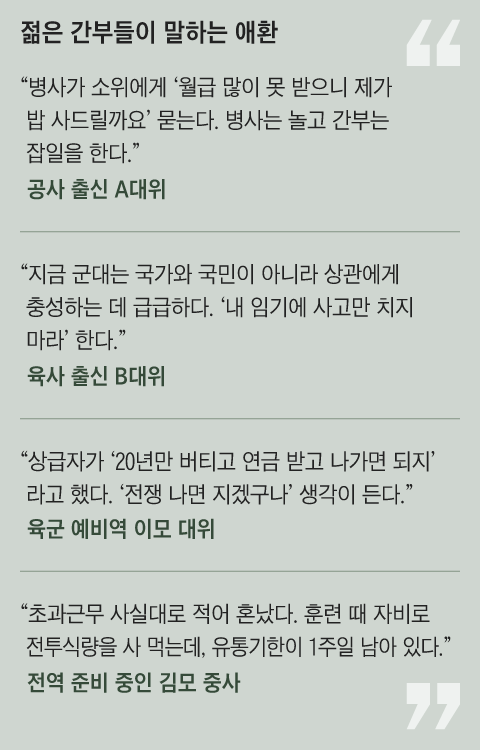
Many junior officers left the military due to a lack of pride in their role. A retired captain said, "A superior once said, 'Just endure 20 years, get your pension, and leave,' which made me think, 'We’ll lose if war breaks out.'" Captain B said, "I joined to serve the nation and people, but the organizational culture focused only on loyalty to superiors suffocated me. I was disillusioned by superiors who only said, 'Don’t cause any accidents during my term.'"
Additionally, the culture where officers in policy units—such as the Ministry of National Defense, military headquarters, or the Joint Chiefs of Staff—advance faster than those in field units accelerates young officers’ departures. Stories like, "A field officer without policy experience failed a lieutenant colonel promotion review," shake military morale. A military insider said, "Rear-unit officers leave on time, but field-unit officers aren’t clearly rewarded. Who wants to endure hardships if they can’t beat those with connections and report-writing skills?"
Captain A noted, "All four-star generals were replaced in the recent promotion. The military’s policy continuity is breaking down." Since the December 3 emergency martial law, the military leadership has faced successive investigations, creating chaos. He added, "I believe national defense strengthens when the military is independent from politics, but seeing four-star generals replaced so easily deepened my worries about the military’s future."
Корейские военные не могут разработать дроны-камикадзе
Сокращение численности вооруженных сил ожидалось еще в 2005 году, когда правительство Но Му Хена обнародовало «Оборонную реформу 2020». С тех пор, с каждой сменой администрации, Министерство национальной обороны внедряло передовые технологические планы, такие как «Оборонная реформа 2.0» и «Оборонные инновации 4.0», утверждая, что они направлены на решение проблемы нехватки рабочей силы, вызванной «демографическим обрывом». Однако эти планы по созданию «умной армии» не принесли ощутимых результатов.
В 2018 году, на фоне ухудшения низкой рождаемости, правительство Мун Чжэ Ина сократило срок обязательной военной службы с 21 месяца до 18 месяцев (по армейскому стандарту). Он также включил меры по созданию высокотехнологичной армии с помощью беспилотных боевых систем и автоматизации в «Оборонную реформу 2.0». Армия продвигала проект «Армейский тигр», стремясь стать ориентированными на будущее сухопутными войсками, основанными на технологиях Четвертой промышленной революции.

Ключевым компонентом этой инициативы было обеспечение безопасности «Платформы Воина», передовой боевой системы. Концепция включала в себя оснащение отдельных солдат самым современным снаряжением, таким как новые баллистические шлемы и очки ночного видения, используемые американскими военными, повышение боевых возможностей и передачу информации о поле боя и тактических инструкций в режиме реального времени через передовые сети. Тем не менее, реальное развертывание этой системы, которую когда-то окрестили «корейским Железным человеком», было отложено. В то время как план предусматривал поставку четырех бригад к 2025 году, до сих пор его приняла только «Демонстрационная бригада армейского тигра». Персональные коммуникационные сети и системы визуализации боевой информации остаются неразвернутыми даже в демонстрационном подразделении из-за задержек в разработке.
Ом Хё Сик, генеральный секретарь Корейского форума обороны и безопасности, заявил: «Американские военные используют устройства Samsung Galaxy для ведения боевых действий уже десять лет назад, отслеживая местоположение членов отряда и боевой группы в режиме реального времени и управляя беспилотниками, но наши военные только сейчас рассматривают возможность их внедрения».
Чтобы компенсировать сокращение численности личного состава, в конце 2000-х годов военные ввели концепцию «дронбота» (сочетание слов «дрон» и «робот»), целью которой является мониторинг и нанесение ударов по вражеским целям с помощью беспилотников и замена солдат роботами. Армия даже создала боевое подразделение дронботов. Тем не менее, военный источник отметил: «Только после импорта дрона-камикадзе «Warmate» из Польши в прошлом году военные получили боеспособный беспилотный летательный аппарат». В то время как дроны-камикадзе доказали свою эффективность в войне в Украине, задержки в разработке внутри страны вынудили импорт.
The scientized boundary system (unmanned surveillance system), which the military has been upgrading since the late 2000s to address manpower cuts, is also criticized for limited effectiveness. Though it reduces the need for guards at outposts, it still requires personnel to monitor surveillance camera feeds around the clock. Optical fences installed along barriers trigger alarms in response to external stimuli but are known for frequent false alarms due to sensitivity. Lowering sensitivity to reduce false alarms has sometimes led to missed intrusions. As of this year, an AI-enhanced thermal imaging surveillance system has been partially deployed only in the 22nd Division.
The Army’s multi-purpose unmanned combat vehicle, capable of remote surveillance, reconnaissance, and firing, has undergone development since 2020, with prototypes already produced. However, disagreements among contractors over evaluation methods have stalled even the selection of a model. In contrast, the U.S., UK, and China recently unveiled 16 unmanned combat vehicles at a large-scale military parade, capable of mounting modules for reconnaissance, attack, mine and explosive removal, and support. Chinese media claimed these vehicles operate in diverse terrains like deserts and grasslands in coordination with manned units via communication networks.
Under the Yoon Suk-yeol government, the military began promoting "Defense Innovation 4.0," asserting that AI-based unmanned and robotic combat systems could reduce manpower and costs while enhancing defense capabilities. However, critics argue that the military lacks spaces for experts in AI, drones, and robotics to utilize their skills. A retired lieutenant colonel A, who majored in engineering at the Korea Military Academy and earned a Ph.D. in advanced military systems from a prestigious U.S. university through a military-sponsored program, left the service three years ago, disillusioned by what he called "empty defense reforms." He told this newspaper on the 24th, "Billions are poured into military modernization, but those in charge don’t even know the letter A of AI and are obsessed with short-term results. They create documents and hold seminars for show but fail to implement plans."
Another retired lieutenant colonel B, who earned a Ph.D. in robotics from the Korea Military Academy, stated, "Importing drones isn’t enough for genuine defense reform. The personnel system and operational concepts must be overhauled." He emphasized that even talented individuals with a sense of mission cannot work in their specialized fields or advance under the current system, leading them to leave the military.
Despite these issues, the Ministry of National Defense claims defense reforms are progressing as planned. During the Moon Jae-in administration, it claimed an 80% achievement rate for "Defense Reform 2.0," while the Yoon Suk-yeol government reported a 44% achievement rate for "Defense Innovation 4.0" within a year of its 2023 announcement. A military source criticized, "There’s a tendency to include easy-to-achieve tasks in defense reforms and showcase them. Each government proclaims reforms, but the names just change."
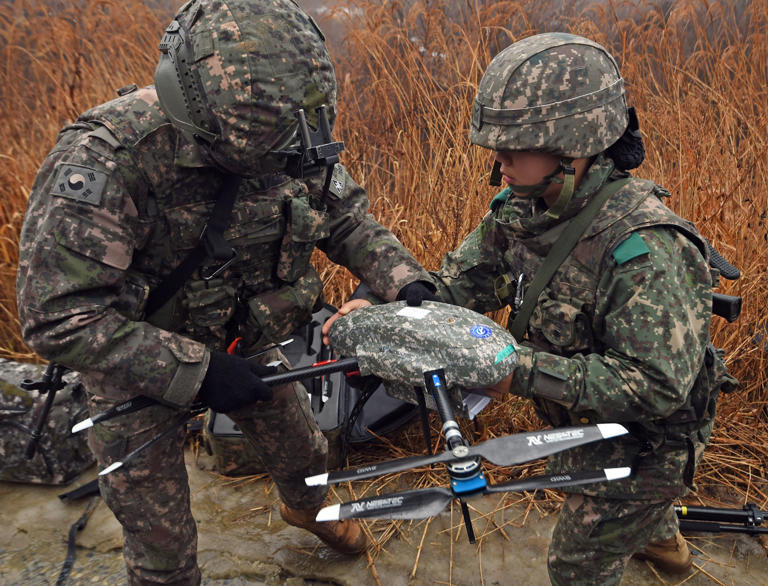
Солдаты из «бригады пилотов Amitiger» собирают разведывательный беспилотник во время совместных учений США и Южной Кореи, состоявшихся в январе 2023 года на полигоне Мугун-ри в Пхаджу, провинция Кёнгидо. Армия планирует к 2040 году превратить все боевые бригады в подразделения «Амитигер», а к 2025 году иметь в своем составе четыре бригады пилотов. Однако из-за задержек существует только одна бригада пилотов, назначенная на 2022 год. /База данных Чосунильбо