




|
Эксклюзив: К 2028 году рынок инновационных лекарств в Китае станет третьим по величине в мире
|
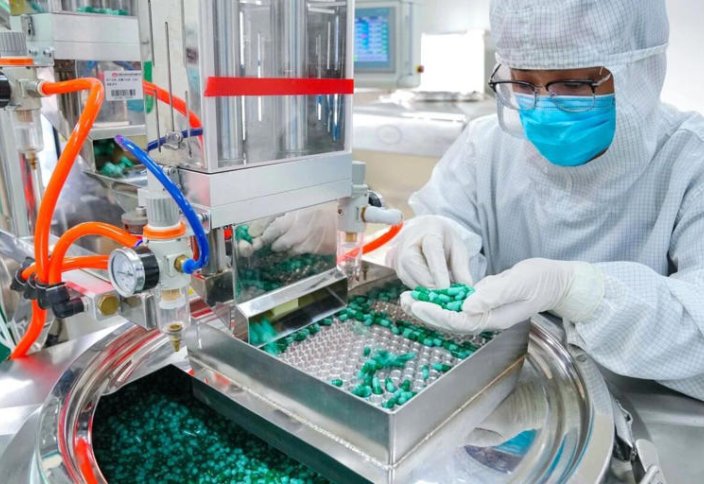
Появились результаты опроса, свидетельствующие о том, что Китай, который быстро развивается в биосфере, включая открытие новых веществ-кандидатов в лекарства, намерен стать одним из трех ведущих мировых рынков инновационных лекарств. Согласно отчету McKinsey & Company «Asia Biopharma Report», который будет опубликован в конце сентября, было проанализировано, что Китай скоро обгонит Германию, которая в настоящее время занимает третье место в мире по размеру инновационного рынка.
Хотя Китай является вторым по величине фармацевтическим рынком в мире, он считался слабым игроком на рынке инновационных лекарств, поскольку дженерики (дженерики) составляют большинство. Однако в последние годы доля новых препаратов стремительно увеличивается. На данный момент 15 инновационных препаратов, выпущенных Китаем, превысили 100 миллионов долларов (около 140 миллиардов корейских вон) по продажам, и среди них есть новые препараты, ставшие блокбастерами (препараты с годовым объемом продаж более 1 триллиона вон). Это является предпосылкой для анализа, свидетельствующего о том, что китайский биорынок совершает заметный качественный скачок, выходящий за рамки количественного роста.
◇ Китай станет третьим по величине рынком инновационных лекарств в мире
According to the McKinsey report, the Chinese pharmaceutical market in 2023 was worth $125 billion (approximately 174 trillion won). Among these, the innovative drug sector has been driving the market with an average annual growth rate of 16%. Notably, China is growing rapidly centered around domestic companies. McKinsey projected that while multinational pharmaceutical companies held a 75% market share in 2023, this figure is expected to decrease to 60% by 2028. The report also predicted that although China’s innovative drug market has so far lagged behind the U.S., Japan, and Germany, it will overtake Germany and rise to third place by 2028.
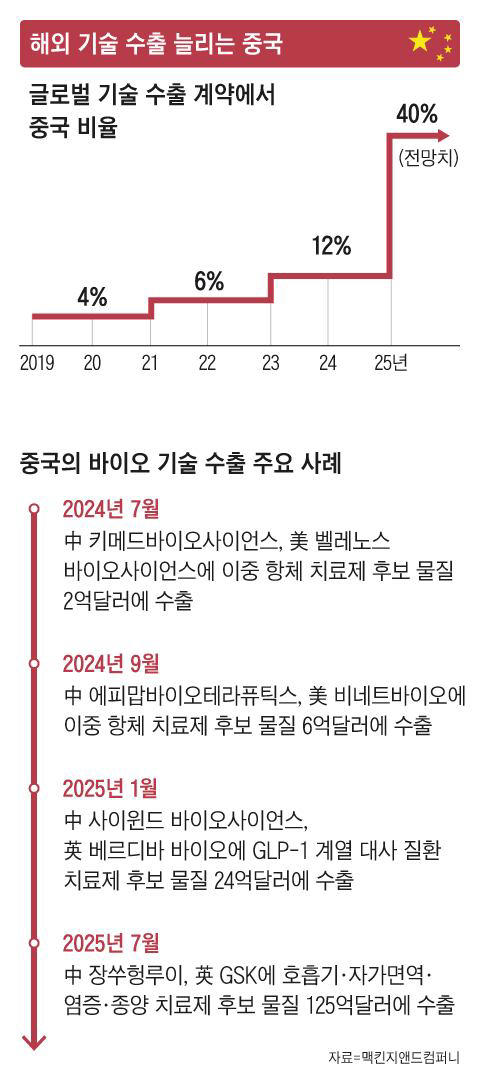
The rapid growth of China’s innovative drug market is attributed to over 12 bio-innovation hubs. These hubs are rapidly enhancing technological capabilities. The Chinese government’s active R&D support and regulatory innovations have also provided significant assistance. Thanks to significantly lowered regulations, the period for new drugs to be listed on insurance has been shortened, thereby rapidly expanding the market. The scale of China’s technology exports for new drug candidate substances continues to grow. It increased from $10 billion in 2019 to $57.5 billion in 2024. While China’s share of global technology exports for new drug candidate substances was only 4% until 2019–2020, it is projected to reach nearly 40% by 2025. The rapid development of pharmaceutical contract manufacturing technology is also influencing the growth of China’s innovative drug market. Currently, three out of the top 10 global big pharma companies are outsourcing drug production to China.
◇15 инновационных препаратов в Китае уже превысили 100 миллионов долларов
Fifteen of the innovative drugs developed in China have already exceeded $100 million in sales. Notably, BeiGene’s blood cancer treatment (commercial name Brukinsa) recorded annual sales of $1.3 billion (1.8189 trillion won) in 2023. Last year, its sales surpassed 2 trillion won, reaching $2 billion (2.8 trillion won). Globally, drugs with annual sales exceeding 1 trillion won are typically referred to as “blockbusters.” McKinsey & Company’s Partner Park Junhyeong stated, “Brukinsa is the first blockbuster developed in China and the first Chinese drug to receive FDA (U.S. Food and Drug Administration) approval as an anticancer agent, demonstrating that China’s new drug technology has significantly matured.” Legend Biotech, a Chinese bio company, also achieved approximately $960 million (1.336 trillion won) in sales last year with its multiple myeloma treatment ‘Carvykti,’ which was exported to Janssen. This is why there are discussions suggesting that China is likely to continuously produce blockbusters in the future.
◇ Скорость разработки новых лекарств: в два раза быстрее, чем в среднем по миру
According to the McKinsey report, China is also a country where the speed of deriving preclinical candidate substances is more than twice as fast as the global average. This means that the stage of finding candidate substances in the new drug development process progresses much faster than in other countries. Partner Park Junhyeong explained, “While global pharmaceutical companies take 4–6 years to discover targets and finalize candidate substances, recent Chinese biotech firms can complete this process in 2–3 years,” adding, “This is the result of AI (artificial intelligence)-based drug discovery and the simultaneous investment of thousands of personnel and massive capital.” The large population also serves as an advantage, as it allows for a larger pool of clinical patients, thereby accelerating the pace of new drug clinical trials. A source from the bio industry stated, “China has solid foundational bio research, with a rapidly increasing number of medical papers published in leading scientific journals such as *Cell*, *Nature*, and *Science,” and emphasized, “To avoid falling behind China in pharmaceutical bio technology, the Korean bio industry and government must establish countermeasures.”
※ Эта статья была переведена компанией Upstage Solar AI.